


Yes, the material must be acclimated before installation. Handle the boxes with care. There are specific requirements depending on the technologies. First, make sure the boxes reach room temperature. Store them at the installation site for at least 24 hours in their original packaging, at a temperature of approximately 22 °C (72 °F) and a relative humidity of about 45%. Do not open boxes or remove plastic wrap before starting installation to avoid changing the humidity level inside the box.
The subfloor must be dry and meet all recommended guidelines.
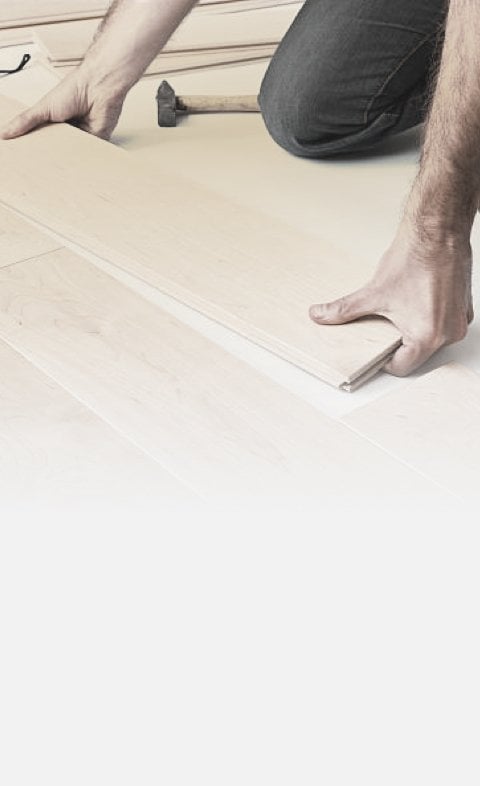
Please read the installation guide before proceeding with the flooring installation.
Installing hardwood on vinyl can be difficult. It depends if the vinyl adheres well to the subfloor and is cushioned. If the vinyl is not securely fastened to the subfloor, the wood floor could lift up and separate from the subfloor. On the other hand, if the vinyl is cushioned, the hardwood floor may creak. For best results, install a hardwood floor on a clean, flat, solid subfloor that meets the manufacturer's recommendations. See our installation guides for more details.
To ensure optimal acoustic performance, TruBalance, TruBalance Lite, and Lock flooring technologies can be installed with an acoustic underlayment.
Floated installation: We recommend using the AcoustiTECH underlayment, distributed by Mirage, or any other underlayment that meets the criteria outlined in Technical Newsletter #20.
Double-glue installation: Ensure that the underlayment and the pad/assembly comply with the minimum criteria outlined in Technical Newsletter #26.
IMPORTANT: It is not possible to use underlayment when installing with fasteners.
For full installation details, please refer to the installation guides and technical bulletins.
TruBalance and TruBalance Lite floors may either be glued down over plywood/OSB or concrete subfloor or simply nailed/stapled down over plywood/OSB floor, using a specially designed hardwood floor stapler or nailer or floated over a recommended underlayment. However, Herringbone and Chevron flooring are exceptions—please refer to the Herringbone and Chevron Installation Guides for further details.
- Stapled down installation requires minimum 5/8” (16 mm) plywood, or 23/32” (18 mm) OSB chipboard subfloor.
- Concrete subfloors must be in good structural condition and have a compressive strength of 3000 psi (20.7 MPa).
- For floorboard widths of 7-3/4 inches or wider, glued-assisted is mandatory for nailed/stapled down and floated installations. For more details, refer to Technical Newsletters #20, #30 or #36, depending on your installation method.
Lock floors can be installed using a glue-down or floating method over plywood/OSB or concrete subfloor, or over an existing flooring, as these materials meet the requirements and recommendations set out in the installation guide. They should never be installed on carpeting or any other soft floor covering. Glueless installation requires the Mirage recommended waterproof acoustic membrane recommended by Mirage. For more details, see Technical Bulletin #20. Stapled down installation requires minimum 5/8” (16 mm) plywood, or 23/32” (18 mm) OSB chipboard subfloor. Concrete subfloors must be in good structural condition.
Solid floors can be stapled or nailed to a wood subfloor consisting of plywood with a minimum thickness of 5/8” (16 mm) or OSB chipboard subfloor of 23/32” (18 mm), provided the structure includes joists spaced 16″ (400 mm) apart center-to-center.
Only 3-layer engineered hardwood floors—TruBalance, TruBalance Lite, and Lock—can be installed over a concrete slab. These products are designed to provide optimal stability when installed according to the methods outlined in their installation guide.
For a successful installation, it’s essential to use the recommended adhesives and a compatible vapor barrier if required (see Technical Newletter #23 for details). For floated (non-glued) installations, it is also recommended to first install a waterproof acoustic underlayment approved by Mirage (see Technical Newsletter #20).
These precautions ensure a durable and high-performing installation.
Note: Solid hardwood floors must not be installed directly over a concrete slab.
It is possible, but we suggest installing a ceramic surface around your fireplace to reduce the possibility of sparks on hardwood. However, to ensure the floor remains in a good condition, the ambient humidity must be maintained according to the recommendations of your technology. (Solid: 35–55% | TruBalance: 25–80% | TruBalance Lite: 25–70% | Lock: 30–60%)
Felt paper is used to reduce and delay moisture transmission from the subfloor to the wood floor.
It is very important to clean the glue as you are installing. If the glue is visible, use the cleaner recommended by the manufacturer of the glue used, mineral spirits, acetone, or lighter fluid and apply with a clean white cloth. Always use these products carefully and test on a concealed surface to ensure they do not damage the floor. Avoid rubbing vigorously for too long.
Before installing a Mirage floor, the subfloor should always be tested to ensure that it is at the correct moisture level. All potential sources of moisture should be eliminated to avoid future moisture problems. However, relative humidity should still be monitored. For optimal results, maintain relative humidity at around 45%.
There is also the potential for damage from liquid on your floor if improperly cleaned. Clean up spills right away to prevent lasting damage and use Mirage cleaner as directed in our Residential Maintenance Guide.
The National Wood Flooring Association also has a great resource in their Find A Certified Professional tool linked here.
https://industryguide.hardwoodfloorsmag.com/professional-search
It’s recommended that you seek out the services of installation specialists who guarantee their work, given the importance of your investment in your hardwood floor and the long-term stakes surrounding its installation.
Yes, it is necessary to select the right technology and to carry out the correct preparation on the subfloor. Refer to our installation guides to make sure you follow the recommendations.
Absolutely! Hardwood flooring can be used as an attractive and durable wall or ceiling cladding. However, it’s essential to comply with all applicable local building codes and regulations before installation.
For detailed instructions, please refer to the installation guide for hardwood flooring on interior walls and ceilings.
Absolutely. Our TruBalance, TruBalance Lite, and Lock products can be installed over radiant heat, except for Hickory. Due to its physical properties, this species is not suitable for such installations. For more details, please refer to your Mirage installation guide and Technical Newsletter #31.
Note that it is not possible to install Solid wood flooring over radiant heat.
Highly moist environments, such as full bathrooms where you find sink, toilet, bathtub, and shower or even powder rooms and half-baths are not recommended for hardwood.
Yes—just be sure to take precautions with anything that could cause moisture damage to the floor. If a spill occurs, clean it up quickly. In addition, an engineered floor, which is made of a hardwood top lamella over a core layer, will tend to offer better strength than Solid technology. You can also choose a floor that is more permissive to visible damage and can hide the marks more easily (color, grain, species).




 Get your samples
 Find a


